
《Resident Evil 9: Requiem》 Game Description
Capcom's latest survival horror title, 《Resident Evil 9: Requiem》, is set to release soon. This installment brings significant innovations to the nearly 30-year-old Resident Evil franchise, not only preserving its two core traditions but also overhauling its gameplay and design to keep veteran players on edge once again.
This title masterfully blends the series' early survival horror ethos—characterized by its slow-paced, cautious approach and emphasis on resource management—a philosophy further reinforced in Resident Evil 7 and Resident Evil 2 Remastered. Yet Resident Evil 9 retains the intense action rhythm of Resident Evil 4 Remastered, with its dual-track design achieving an unprecedented balance between atmosphere and gameplay mechanics.
A talking zombie
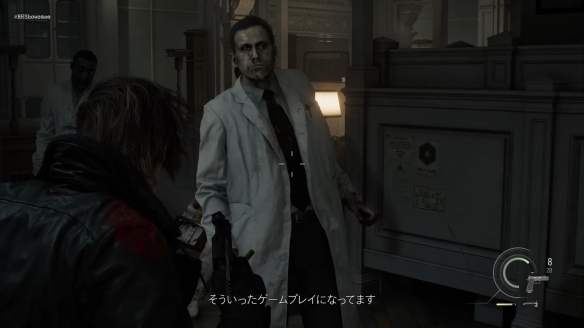
As the iconic presence of Resident Evil, the zombie in Requiem has evolved significantly since its debut in the series: it is no longer merely an unconscious corpse but retains remnants of its former personality and habits.

Producer Aoki Aoki revealed that most of these zombies had recently contracted the virus, retaining residual memories of language and behavior. During gameplay, players encountered two zombies staggering forward while exchanging fragmented, illogical phrases—as if continuing to repeat their daily interactions from life before.
The Resident Evil series has never been without "speaking zombies"—from the iconic "itchy, tasty" note left in the first game's caregiver diary, to Brad Vickers' ghostly apology in Resident Evil 3 Remastered, which embodied the zombie aesthetic, to The Requiem, which for the first time integrated the concept of talking zombies into its core design.
The individual personality and habits during life influence every encounter.
Zombies with distinct personalities significantly influence combat and level design. Each zombie retains its original profession or behavioral patterns, ensuring every encounter offers unique experiences. For instance, a cleaner zombie will persistently wipe bloodstains in the bathroom; if the player chooses to let it go upon first meeting, they may encounter it again in the corridor continuing its "cleaning" mission.

In the kitchen, a burly chef zombie is fixated on preparing "dinner." If you sneak past it, encountering it again later will make it an extremely dangerous threat.
There is also a female zombie who sings and dances while spinning in place; upon detecting players, she emits a piercing scream to attract other infected individuals. According to medical records from the psychiatric hospital, she was diagnosed with "Protagonist Syndrome" during her lifetime. The zombie also utilizes items associated with her pre-death behavior as weapons, such as wine bottles and IV stands.
Zombies become production resources
Another major overhaul in 《Requiem》 ties zombie kills directly to resource acquisition: one of the two protagonists, Grace Ashcroft, can extract blood from defeated zombies to produce ammunition and other survival essentials.
In previous Resident Evil games, killing zombies typically only consumed resources without providing direct rewards. Anthem reverses this logic by allowing players to obtain resources during combat, albeit at a risk —for instance, the blood-drawing syringe occupies limited slot space in the item inventory and requires time to use, creating additional decision-making pressure when enemies are nearby.
Notably, the locations of blood resources left by players are automatically marked on the map and can be collected later.
The production system has been completely renovated.
Compared to the past when merchants purchased formulas directly, the production and learning process for "Requiem" is more intricate. Grace must collect experimental samples at the Rhodes Mountain Rehabilitation Center and submit them to specialized machinery for analysis. The samples also occupy space in her backpack, and the analysis process requires solving puzzles through a molecular arrangement game.
As the game progresses, the puzzles become increasingly challenging; only by solving them successfully can players unlock new crafting recipes. GameSpot notes that this "extra layer of difficulty" design further intensifies the sense of survival pressure.
Stealth has become the primary gameplay mode.
Stealth in this game is no longer just occasional scenes; it is deeply integrated into Grace's overall gameplay design. Compared to the more linear stealth sequences in Resident Evil 4, Grace enjoys greater freedom, allowing her to utilize tools like throwing glass bottles, environmental sounds, and even the unique behaviors of zombies to adapt to various situations.

Players can tap piano keys or smash pottery jars to lure enemies away, but Grace lacks the standard silent execution ability—unless she uses the extremely rare purple syringe, which can take down ordinary zombies with a single strike, though it's hardly cost-effective and should typically be reserved for critical moments.
Several pursuers appeared simultaneously.
Following "Tyrant", "Mrs.Timitescu", and the Beck family, "Requiem" introduces multiple high-stakes pursuit enemies all present simultaneously.
The trial version features a colossal eyeball woman lurking in the shadows and massive monsters that act like moving obstacles, capable of squeezing into tight spaces. GameSpot notes that Capcom has seemingly fused the traits of several classic pursuer characters into a single experience for players.